
How many people in our municipality actually cycle – and above all: where? For many cities and districts, this is still a question answered with estimates rather than data. The STADTRADELN campaign provides reliable answers once a year. We have been involved in the technology behind it since 2018.
STADTRADELN makes cycling visible – and measurable
In STADTRADELN, a campaign by Klima-Bündnis Services, citizens collect cycling kilometres for their municipality over 21 days. In 2025, more than 3,000 municipalities and districts took part. Two goals are in the foreground: to show how many emissions cycling can save, and to promote the bicycle as a healthy form of everyday mobility.
For municipalities, a third aspect is decisive for planning. They get an overview of where and how much cycling takes place within their borders. Unlike a fixed counting station, which captures a single cross-section, the campaign produces a comprehensive picture of the routes that people actually ride. This makes it possible to assess the effect of cycling measures that are already in place – and to plan the next measure based on data rather than on gut feeling.
Our own location shows how meaningful this is. In Dresden, more than 9,400 people cycled 1,917,165 kilometres in 2025 – a record. In 2022, there were only around 6,900 participants, and even more are expected this year in the period from 7 to 27 September.
Since 2018: Cyface technology in data collection
Since 2018, the software of Cyface GmbH has been a central building block of the data collection in STADTRADELN. We take care of capturing the trips on the smartphone and of storing them securely.
Over the past years, we have extensively tested and further developed our smartphone SDKs for Android and iOS for this purpose. The result: they reliably record data even on very large, heterogeneous device fleets and transfer it to our servers – across the widest range of hardware, operating system versions and power-saving mechanisms. The latter in particular is the most common cause of gaps in recordings in practice, and therefore a focus of our work.
The real challenge: estimating capacity correctly
What makes such a deployment technically demanding is less the single recording than the sum of them. Each municipality chooses its own 21 days between May and September. This creates a load that shifts strongly over the season – with peaks at every campaign start, on sunny weekends and in the evening hours, when many devices transfer their trips at the same time.
The hardest question is the same for us every year: how much server capacity do we need? If we estimate too high, operation becomes unnecessarily expensive. If we estimate too low, we run into problems in the middle of the campaign. Our work lies exactly in between.
That is why we have deployed our cloud infrastructure with a high degree of redundancy and equipped it with extensive monitoring. The measurement data from each season in turn feeds into the planning of the next one.
Data protection and data security at scale
With a deployment of this size, data protection and data security are anything but trivial. We store the data in compliance with the GDPR and support Klima-Bündnis Services, the operator of STADTRADELN, in meeting the legal requirements of such an extensive data collection.
For municipalities, this is more than a formality: cycling data is movement data, and without proper anonymisation and a sound data protection concept, a comprehensive survey is simply not permitted.
What becomes of the raw data
In STADTRADELN, we pass the prepared data on to the analysis tool BIKE MONITOR. We have implemented such interfaces to external tools many times.
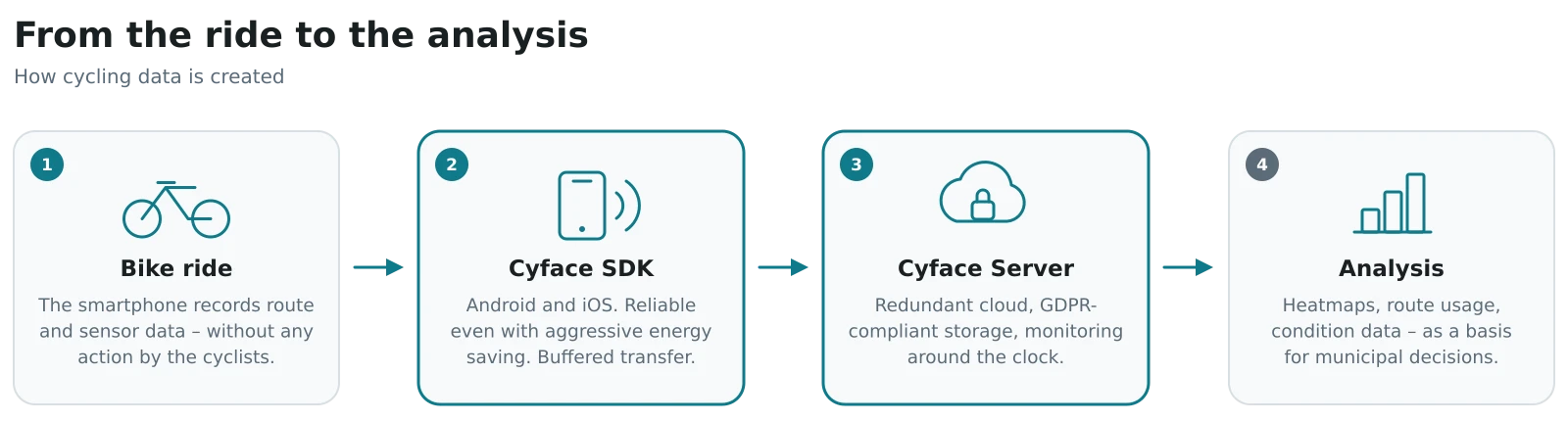
After all, which analysis makes sense in the end depends on the question: Where does traffic shift after a redesign? Which sections are avoided? How does the picture change between two campaigns? In projects outside STADTRADELN, we therefore also take care of the analysis and deliver results in the formats in which they are needed – right up to the shapefile for your GIS.
STADTRADELN 2026 in Dresden: start on 7 September
At our headquarters in Dresden, it starts on 7 September. Until 27 September, every kilometre counts for three weeks – for the 16th time in a row. We can hardly wait to count along.
Cycling data for your municipality
Would you like to collect and analyse cycling data in your municipality, independently of STADTRADELN? We are happy to advise you – from data collection via SDK or white-label app and GDPR-compliant storage to analysis tailored to your questions.
Request advice